


Redesigned card issuance process to enhance efficiency and save time.
At Emburse Spend, the card issuance process required administrators to enter card details manually for each new card, a cumbersome and error-prone procedure. The Card Template project was initiated to streamline this process by allowing administrators to create and utilize card templates, thereby minimizing manual data entry, enhancing efficiency, and reducing the potential for errors.

ROLE
Product Designer ||
WEBSITE
CONTEXT
Emburse is a fintech company specializing in expense management and spend optimization solutions. Emburse Spend is a spend management platform designed to empower finance administrators in efficiently overseeing employee-driven vendor spend (like software subscriptions and digital marketing expenses.) Through issuing virtual and physical cards with customized usage limits and controls, Emburse Spend enables proactive spend approval, providing customers with real-time visibility and control over their teams' expenditures.
PROBLEM
Currently, the manual process of card issuance was time-consuming and susceptible to human error, which led to inefficiencies, and administrator dissatisfaction. The absence of a centralized system for card templates often resulted in unnecessary duplication of efforts and increased the likelihood of mistakes.
FINAL SOLUTION
Implementing a feature enabling administrator to effortlessly order cards using predefined templates that included merchant restrictions, budgets, and other card details. This will eliminate the need for repetitive data entry for each card and significantly speeding up the process.
SUCCESS METRICS

RESEARCH
Surveyed 28 existing customers to understand the need and use-case around copying card details while issuing new cards and how we can do better.
We distributed the survey via email to recently active (Past 3 months) Emburse Spend Admins. We reached out to around 225 spend admins and within a week received 28 responses.
50% of participants said that they made copies of cards frequently.
The responses were evenly divided between customized cards and similar or duplicate cards
64% of participants were interested or Very Interested in using a card template feature
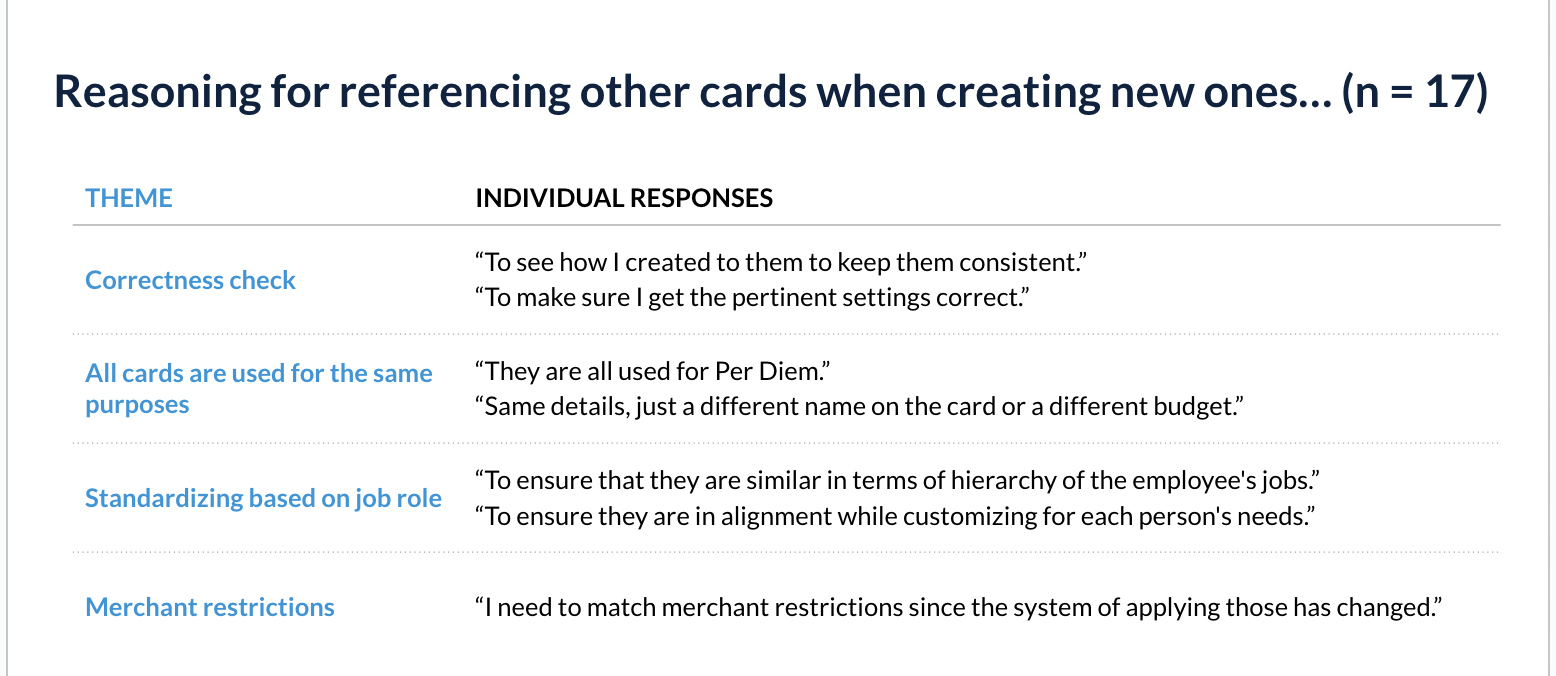
Reasons behind referencing previously issued cards when creating new ones
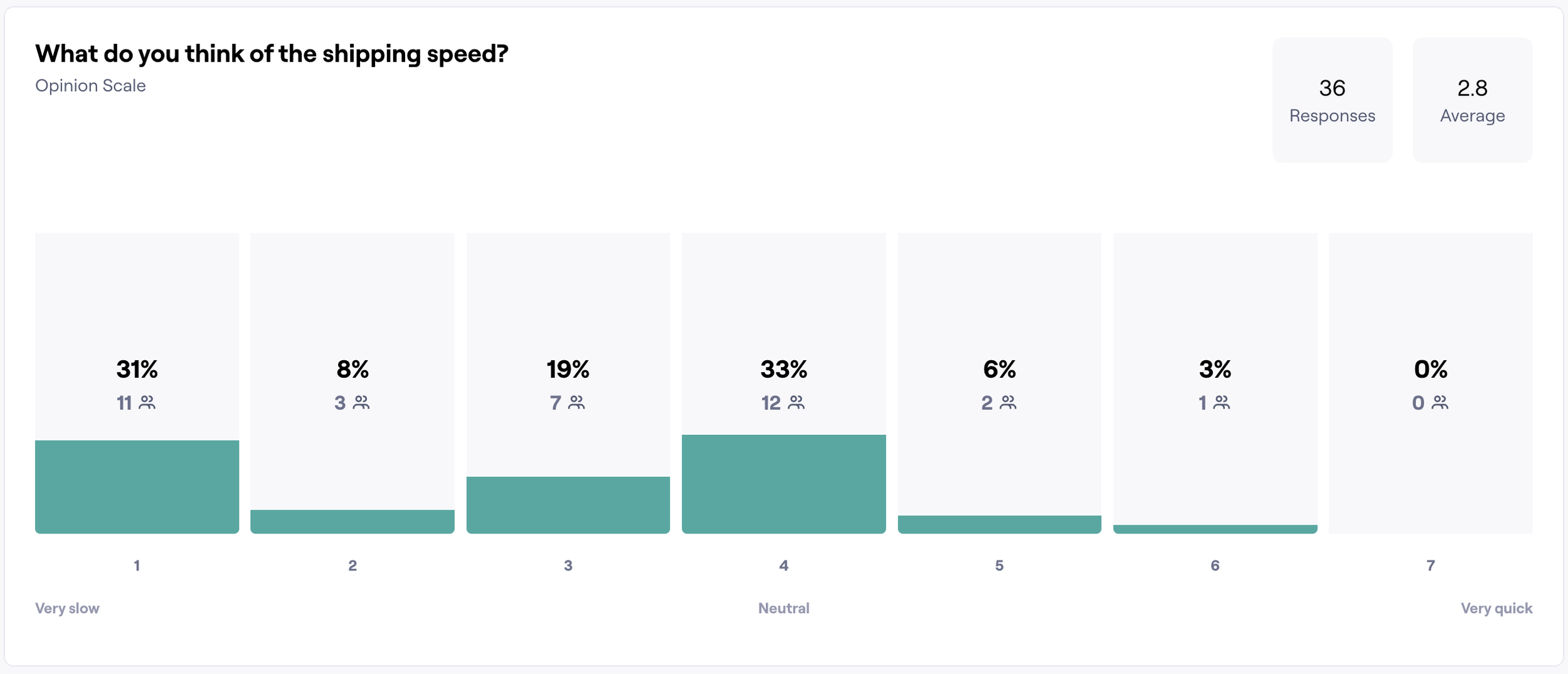
Additional Finding - Card Delivery Speed Dissatisfaction
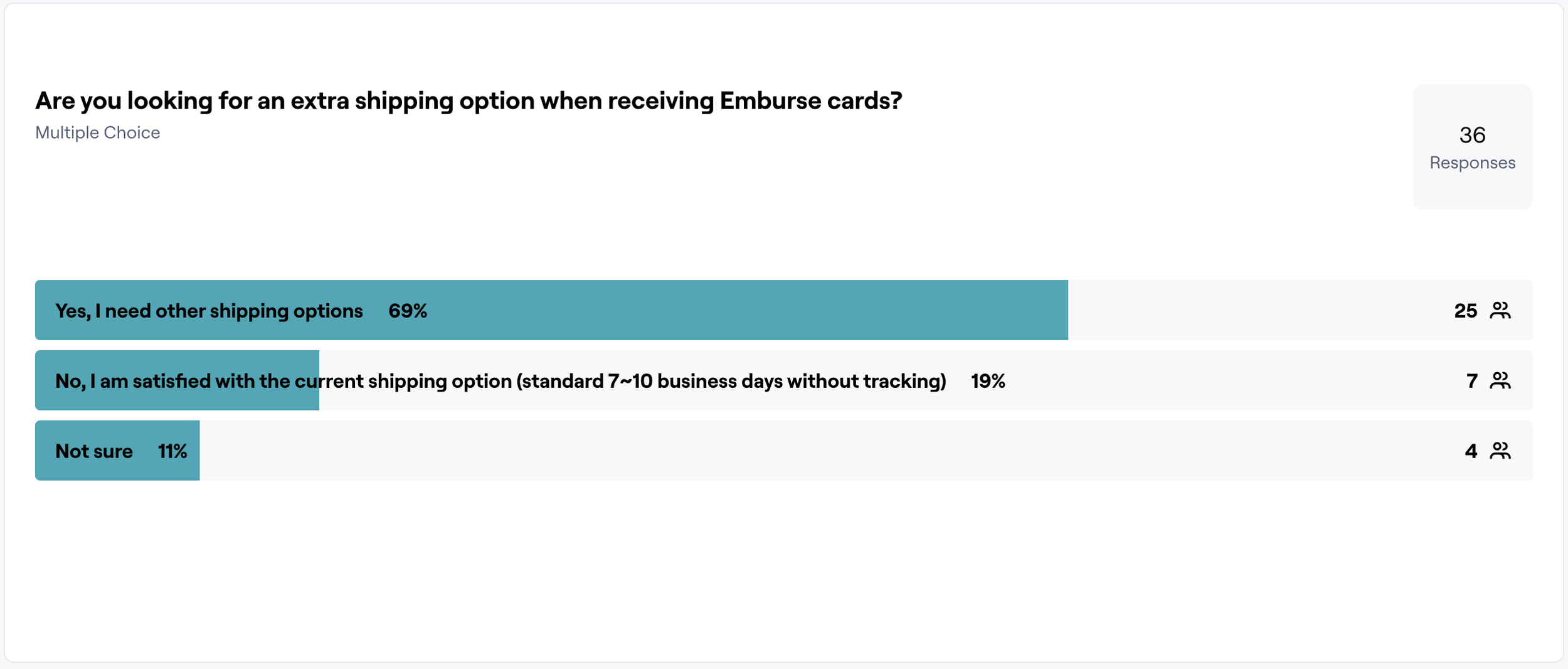
Analysis of initial survey feedback revealed customer dissatisfaction with card delivery speed. Subsequent survey aimed to assess user satisfaction with current mailing service and preference for alternatives. (Number of Participants: 36)
70% of the clients are looking for extra shipping options.
User Quotes from Survey of why they are Interested in Card Template feature
“Because most of our cards are the same it would be helpful to be able to create cards under a different name with the rest of the details being consistent.”
“It could cut down on time when issuing a new card assigned to an existing client.”
“Seems like a nice feature. Avoid duplicating work.”
“Anything that can save time and energy, as well as create standardization, is a win in my opinion.”
“Over the year several people will end up purchasing the same type of items over and over. Having a template will help them request a card quicker and have the same consistency in account number.”
“Always up for process improvements.”
DESIGN - BEFORE CARD TEMPLATES
USABILITY TESTING
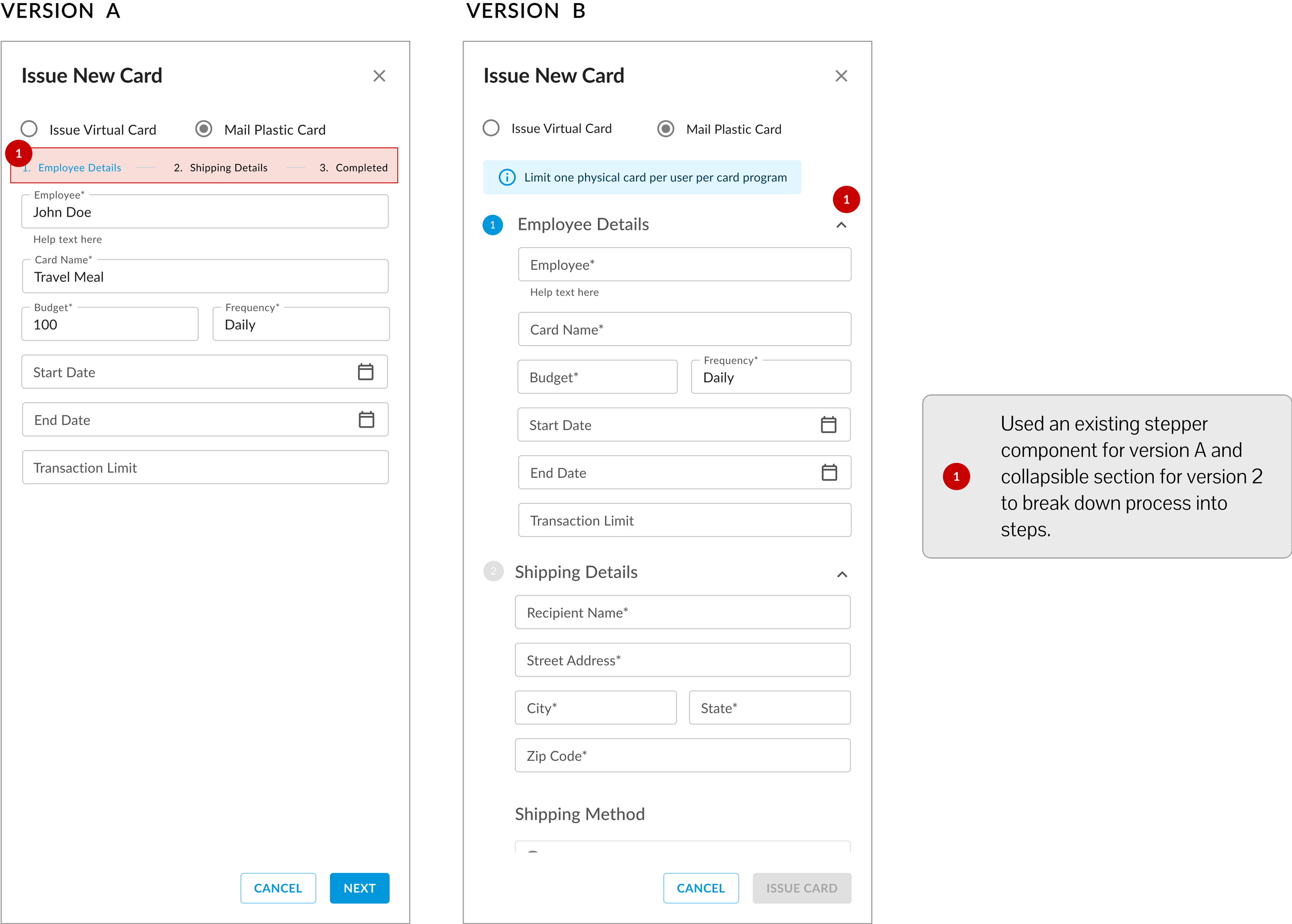
Designed iterative enhancements for Shipping Methods and Card Templates followed by conducting usability testing with 8 participants to assess the intuitiveness of the user experience and determine their preferred version.
Shipping Methods Iterations: Explored various UI enhancements to introduce additional shipping options for physical card issuance.
Card Templates Analysis: Collaborated with the Product Manager to analyze data on frequently used card categories and created user-friendly templates based on merchant restrictions and card types.
TASK 1
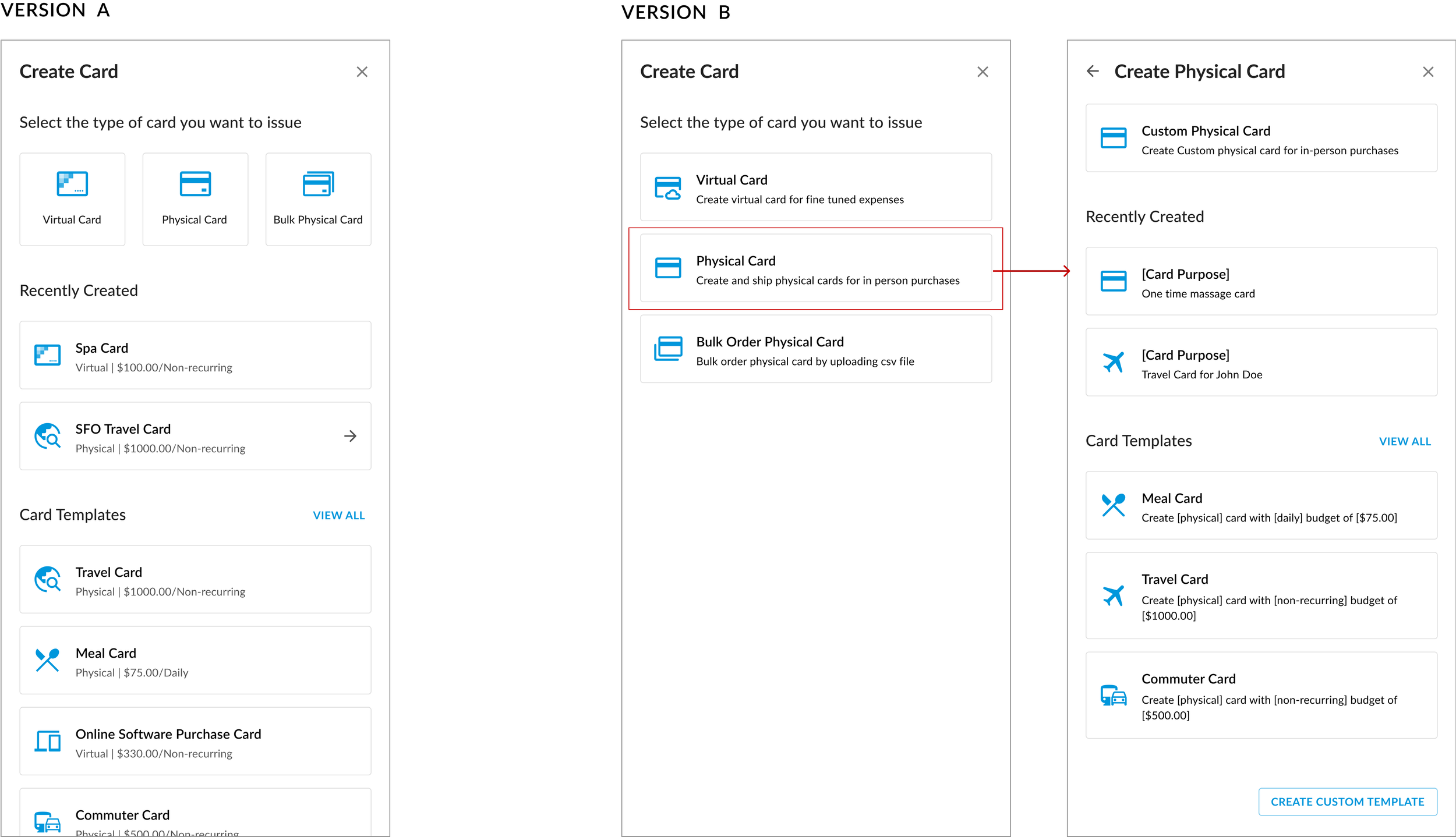
Issue a physical meal card using Card templates.
75% of participants liked version B
“Used to do it the method I knew. Didn't even notice templates” - Version A
"I like step-by-step interfaces asking you to make one choice and move on to the next one. It is less confusing, plus no training is needed" - Version B
"Version B offers more clarity and makes it easier for users to make decisions than Version A, which is overwhelming."
TASK 2
Issue a physical card and let us know which version you prefer, could you please explain the reasoning behind your preference?
25% preferred Version A, 75% preferred Neither
"Version A offers a more intuitive and user-friendly experience. Breaking down information into smaller steps allows for focused attention, reducing errors.”
“It’s important for me to quickly scan each section, saving me time and helping me collect all the required details efficiently. I love to see all the sections in the single-page design.”
FINAL DESIGN
Based on the feedback from usability testing, I iterated the design and moved on to create High Fidelity wireframes
ADMIN VIEW FOR ISSUING CARD USING TEMPLATE
ADMIN VIEW FOR MANAGE CARD TEMPLATES
Learnings
Conduct research early and continually validate assumptions with user input throughout the design journey.
Iteration is key; there's always room for improvement.
Even though some requirements may only pertain to a minority of users, consider additional use cases that may meet the needs of multiple user types in the future.